
If you have found a grounded bat? Ring the Bat Conservation Trust Helpline on 0345 1300 228
or visit the BCT website https://www.bats.org.uk/our-work/national-bat-helpline
If you have found a grounded bat? Ring the Bat Conservation Trust Helpline on 0345 1300 228
or visit the BCT website https://www.bats.org.uk/our-work/national-bat-helpline
Projects are time limited with planned oucomes. For larger projects we may seek external funding. Projects are in addition to our ongoing annual work of bat care, box checks and repair, acoustic surveys, supporting the National Bat Monitoring Program, emergence surveys, roost surveys, talks and walks for the public, schools and youth groups. To scroll down to see our three new projects click here
Annual activities and events
Bat Care
Usually gets increasingly busy as the active season for bats progresses. See our page on Bat Care.
Bat Box Checks
We usually check schemes at least once a year but the more highly used schemes in spring and autumn leaving them undisturbed during maternity in June and July. We check the boxes for bats with torches or endoscope both of which require a Natural England licence to disturb the bats. We record the number and species present so we can plot trends in numbers and distribution of species. This may include running repairs or replacement of damaged boxes or installation of new boxes. We are currently adding boxes that can also be used as small maternity roosts.
Schwegler and the box like standard boxes open so we can see the bats inside. With these it is possible to gather further imformation. Having a bat in the hand means a more reliable decision as to the species is possible as we can move them around to see all the features. We can also determine the sex of the bats. This is done wearing a mask so we do not pass any virus or bacteria to the bat, and gloves to protect us from disease from the bats.

Bat box check at Rockley Park, Radcliffe on Trent

Soprano pipistrelle from a Schwegler 2F bat box at NWT Besthorpe Nature Reserve
Static detector deployment
This may be in buildings, outdoors or across woodlands, nature reserves or parks. If outdoors they are usually deployed for 10 to 14 days so they sample the majority of species present at that time of year. Deployment is building may be for shorter periods went we have determined bats are roosting indoors.

Bat Walks
These usually take place from 20 minutes before sunset for upto 90 minutes. We try to pick locations where we know there areseveral species with reliable and good numbers, so we avoid disappointing the public. We can be overwhelmed with requests during the few weeks in May when sunset is not too late and then in August and September as night close in. The best locations often have ponds, lakes or calm rivers or canals where we may see Daubenton's bats catching insects just above or on the water. Water attracts insects so there are usually other bat species present. Soprano and Nathusius pipistrelles especially like water features.
NBG has sets of 15 Magenta bat detectors and lanyards with the frequencies of the bats likely to be heard and hopefully seen. The dial on the front allows you to set the frequency of the species you are listening for and the frequency is displayed in the LED screen. Bat walks are often the first time that people hear bats as their calls are to high a frequency for our ears. When you hear the clicks of a bats echolocation the trick is to look up to the sky and try to see their silhouette. So stand with your back to hedge rows or trees as you will struggle to see bats against dark backgrounds.
You may be able to see bats in your garden or parks around sunset. Pipistrelles sometime will feed on midges attracted by street lights.
Some bats are light averse and will not be seen untill well after sunset when it is dark. These are usually woodland bats such as brown long-eared, Natterer's or Daubenton's.

The video below from a bat walk shows Daubenton's bats flying low over the lake catching flies. Occationally they scoop a fl;y from the water surface with their big hairy feet and tail membrane. The bats zig zaging around are Soprano pipistrelles rapidly changing direction as its echolocation detects a midge.
Bat Talks
We have more time for talks with powerpoint presentations to groups, schools or youth groups in the winter when we are not so busy with bat conservation work. We have a variety of talks of varying length. With children we usually have shorter talks followed by a variety of learning activities and we share learning resources provided by the Bat Conservation Trust.
Stalls at Biodiversity and Green events
We like to participate in such events because these activities reach a broad spectrum of the public. However, we are heavily dependant on volunteers having a day spare of a weekend.

Stall at Bennerley Viaduct open day
The NBMP National Bat Monitoring Program
We encourage and support members to take part in these surveys which span different time periods over the summer. Each type of survey is always at the same time of year with a repeat survey around 2 weeks later. Some surveys require equipment and some skill level while others are suited to the public.
Hibernation survey
Roost count
Field survey
Waterway survey
Woodland survey
Sunset survey.

Emergence survey at Mattersey Church
Clumber Park
The group has worked with National Trust Clumber Park for many years. Many of the bat box clusters there are now tired and falling apart. We are currently mapping the functioning boxes, adding to depleted boxes to continue the provision. We are also working with the park to install new clusters of boxes.
Bats in Churches
Many of our members took part in the Bats in Churches lottery funded project by BCT and Church of England a few years ago. We want to continue this work by approaching local churches to ask if we can look for evidence of bats and if found deploy a bat detecor so we can determine which species is present. Some times rather than just recording the bats echo location in the church to identify the species we will do an emergence survey using thermal cameras to find where the bats roost within the church.
Above
In the video to the left you can see a video of Brown Long Eared bats emerging into a church. The initial footage is taken with a Nightfox Whisker infra red camera. It shines infra red light onto the subject so the infra red sensitive camera can see the bats. Toward the end we swap to a thermal camera that detects heat not light. The white area on the wall shows that the bats have been roosting behind the wall warming it up. That faded after an hour when all the bats had emerged and the wall had cooled down.
Below
The thermal video to the right is taken inside a church looking up to the end wall of a south facing aisle. The Natterer's bats are roosting up behind the last roof beam by the east wall. You can see them moving behind the plaster to emerge into the church where the gap is large enough. Some bats can be seen re-entering the roost. This may be monthers encouraging this years young to come out. They fly around the church to warm up their muscles before exiting the church to hunt for insects. They eat flies and small moths. The type C social calls are more common in the maternity season (June and July) and are thought to help keep pups with the mother.
Below
Natterer's bats emerging from the same church after flying around inside warming up. Mothers encoraging the young to come with them.
Echoes of Echolocation location

The Echolocation location project was a lottery funded project to map the distribution of the 12 species of bat in Nottinghamshire. Look at our past projects page for greater detail. It concluded in 2018 with the production of the book Bats of Nottinghamshire which is basically a bat atlas for Nottinghamshire.
The new Echoes project has the following aims:
New data can be collected in several ways
Environments to be sampled
We need to cover different habitats and foraging grounds.
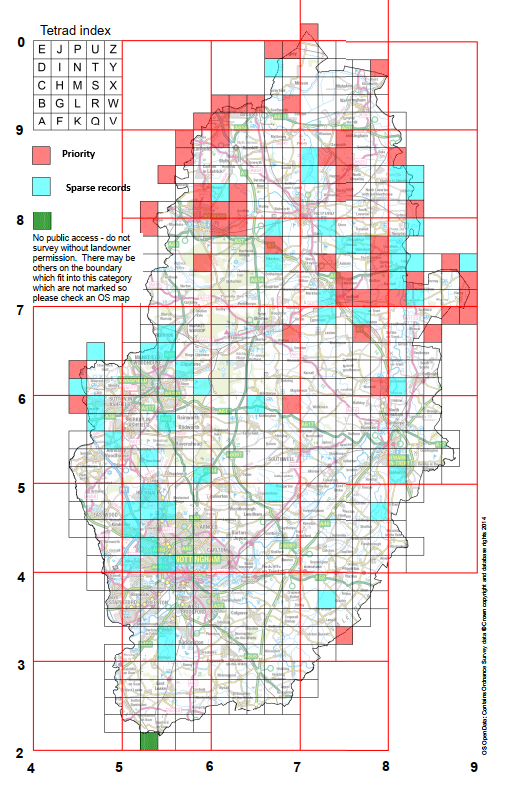
The map to the right shows tetrads (4 square kilometers) covering the county. The red squares are where we need more robust data to reflect the species present. The blue squares could be improved with more records. Our current records may only show the most common species.
There will be group events to deploy detectors in woodlands but members can also help by collecting data from the different habitats mentioned above. Members will be emailed when the project launches in spring 2026. Or after that date email us to request to take part.
Static bat detectors
The bat detectors come on at sunset and will remain in standby untill triggered by ultrasonic sound. (Ultrasonic just means frequencies so high they are above our hearing range). They record the call to SD cards when triggered, then go back to standby. At dawn they switch off.
10 days is usually enough to record the species in an area. You may have to visit in different seasons to record all the bats that use that area. Bats forraging areas change as different insect food sources emerge from pupae during the year.
When the recordings are downloaded to a computer we can use software to listen to the calls and display sonograms which show the frequency of the call on the vertical scale and time on the horizontal scale.

Brown Long-eared call

Common Pipistrelle call
Below is a sequence of pulses from a Common pipistrelle
Across to the right quarter of the sonogram you can see the pulses are closer together, that means they are faster. This is a feeding buzz. It sounds like blowing a raspberry. The faster pulses are because it wants more acurate and recent information about where the insect is, so it can catch it with its feet and tail membrane.
The colour reflects the intensity of the sound from quiet - blue through red to Yellow - loud.

We need your consent to load the translations
We use a third-party service to translate the website content that may collect data about your activity. Please review the details in the privacy policy and accept the service to view the translations.