
If you have found a grounded bat? Ring the Bat Conservation Trust Helpline on 0345 1300 228
or visit the BCT website https://www.bats.org.uk/our-work/national-bat-helpline
If you have found a grounded bat? Ring the Bat Conservation Trust Helpline on 0345 1300 228
or visit the BCT website https://www.bats.org.uk/our-work/national-bat-helpline
The 18 species of bat in the UK make up almost a quarter of our mammal species. Though, we have very few bat species compared to the 1500+ species found worldwide. Bats are found on all continents with the exception of Antarctica. All UK species are insectivorous while bats around the world feed on: nectar, fruit, fish, frogs, and blood.
Generally, the further north you go the fewer bat species found and conversely the further south the more species found. The 6 species of bat not found in Nottinghamshire at present are to be found to the south and west. Five of these species are known to breed in the UK.
While the 18th species had only 1 recorded bat until 2023 when a second was found. It is not known if there is a breading colony.
In addition to these 18 bats there are 2 species that have been occationally recorded but thought to be visitors from europe but not thought to be resident.
Some species of bat have been recorded north of there generally accepted range. It is thought this may be linked to global warming and more specifically to their insect food sources migrating northward. In a similar manner some of the European species may be expected to become resinent in the UK.
There are two species of these bats in the UK. All the other UK bats belong to the Vesper bats Vespertilionidae. These are two different families and have greater differences in anatomy. When roosting their wings wrap around the body rather than fold in at their sides. The horseshoe bats named after the horseshoe shaped leaf of skin around their noses. Their echolocation is also different as call pulses do not start high and fall to lower frequencies like the vesper bats. Instead they start low, rapidly increase to a constant frequency before falling again. The shape is much like a staple. Horseshoe bats also use the doppler shift to sense if insects are flying toward or away from them. The loudest calls are the second harmonic rather than the fundamental (1st harmonic).
To the right is a Lesser Horseshoe bat echolocation. The 2nd harmonic at around 110kHz with the fundamental just visible at 55kHz. As the frequency is so high we usually slow the time expansion by a factor of 20 rather than the usual 10 times. In heterodyne the calls are not clicks like the vesper bats but sound more like the 80's space invaders games.
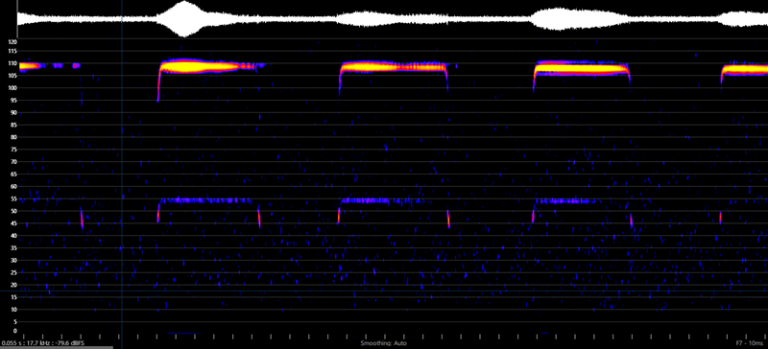
The first 2/3rds are recorded in 20x time expansion while the last 3rd is recorded in heterodyne.
Listen to the video below.
This is one of our larger bat species spaning 4 fingers from head to the tail base.
The first 2/3rds are recorded in 10x time expansion while the last 3rd is recorded in heterodyne.
Listen to the video below.
There are three more bats from the Myotis genus found to the south.
The first 2/3rds are recorded in 10x time expansion while the last 3rd is recorded in heterodyne.
Listen to the video below.
This bat is so similar to the Whiskered and Brandt's bats that it was only identified as a separate species in 2001.
This species had a colony which was found in 1969 but was thopught destroyed by a fire in its roost, a cottage. One bat was then found hibernating but thought to be a migrating vagrant.
This species is very similar to the Brown Long-eared bat but with a very reduced distribution.
These bats are worth mentioning as we may find more of them as global warming expands or shifts their distribution.
In the UK there are records of these bats resting on North Sea oil and gas rigs and in the Shetland Isles.
There are various recordings of Kuhl's pipistrelle in southern England. Kuhl's echolocation is very similar to the Nathusius' pipistrelle so it may be under recorded here. See the BTO pipeline results here.
There are records of this bat being recorded so we need to keep this in mind when identifying bats and calls.
We need your consent to load the translations
We use a third-party service to translate the website content that may collect data about your activity. Please review the details in the privacy policy and accept the service to view the translations.